Pick 3 Mirror Grid Explained — Hidden Patterns
Deep dive into the Pick 3 mirror grid system. Learn how mirror and flip transformations reveal hidden patterns in lottery number sets.

- mirror grid
- pick 3 mirror
- flip grid
- hidden patterns
What Is a Mirror Grid?
A mirror grid is a mathematical transformation tool used by Pick 3 lottery players to uncover hidden patterns in number sets. The concept is simple but powerful: every digit from 0 to 9 has a mirror counterpart, and by mapping your numbers through this mirror relationship, you can discover connected combinations that may not be obvious at first glance.
Think of it like looking at your lottery numbers in a mathematical mirror. The reflection reveals a parallel set of numbers that share a structural relationship with the originals. Experienced players track both the original draws and their mirror counterparts to build a more complete picture of which numbers are active.
How the Mirror Transformation Works
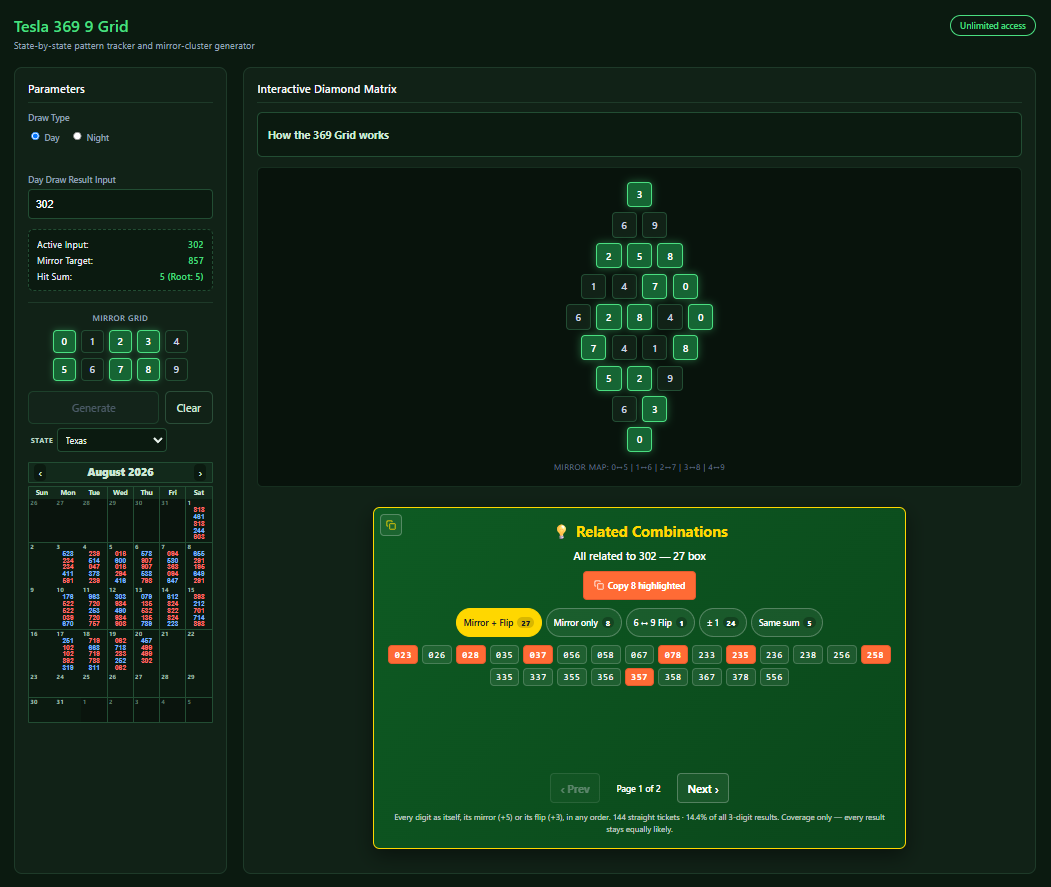
The standard pick 3 mirror system pairs each digit with the digit that is exactly 5 positions away on the 0-9 number line:
- 0 mirrors to 5, and 5 mirrors to 0
- 1 mirrors to 6, and 6 mirrors to 1
- 2 mirrors to 7, and 7 mirrors to 2
- 3 mirrors to 8, and 8 mirrors to 3
- 4 mirrors to 9, and 9 mirrors to 4
The relationship is reciprocal: if 3 mirrors to 8, then 8 mirrors back to 3. This creates five mirror pairs: (0,5), (1,6), (2,7), (3,8), (4,9).
To find the mirror of any Pick 3 number, simply transform each digit independently:
- 4-7-2 becomes 9-2-7 (4 to 9, 7 to 2, 2 to 7)
- 1-3-6 becomes 6-8-1 (1 to 6, 3 to 8, 6 to 1)
- 0-5-0 becomes 5-0-5 (0 to 5, 5 to 0, 0 to 5)
The Flip Grid: A Second Transformation
While the mirror grid adds 5 to each digit, the flip grid uses a different transformation that reverses the digit around a central axis. The flip mapping works as follows:
- 0 flips to 0, and 5 flips to 5 (these are fixed points)
- 1 flips to 9, and 9 flips to 1
- 2 flips to 8, and 8 flips to 2
- 3 flips to 7, and 7 flips to 3
- 4 flips to 6, and 6 flips to 4
The flip transformation subtracts each digit from 10 (with 0 mapping to 0). This creates a different set of relationships:
- 4-7-2 flips to 6-3-8
- 1-3-6 flips to 9-7-4
- 5-5-5 flips to 5-5-5 (the only self-flipping triple)
Now you have three versions of every number: the original, the mirror, and the flip. This triple perspective is where the power of grid analysis emerges.
Finding Hidden Patterns Across Grids
The real value of the mirror grid and flip grid comes from tracking these transformations over multiple draws. Here is a practical example:
Suppose the last five Pick 3 drawn numbers were: 4-7-2, 8-1-5, 3-6-9, 0-4-7, 2-9-3.
Now generate the mirror and flip for each:
- Draw 1: Original 4-7-2, Mirror 9-2-7, Flip 6-3-8
- Draw 2: Original 8-1-5, Mirror 3-6-0, Flip 2-9-5
- Draw 3: Original 3-6-9, Mirror 8-1-4, Flip 7-4-1
- Draw 4: Original 0-4-7, Mirror 5-9-2, Flip 0-6-3
- Draw 5: Original 2-9-3, Mirror 7-4-8, Flip 8-1-7
Look at the mirror column. Notice that Draw 3's mirror (8-1-4) contains the digits 8 and 1, which appeared as the original digits in Draw 2 (8-1-5). This kind of crossover between original draws and mirror transformations of other draws is exactly the type of hidden pattern that grid analysis reveals.
Also notice that Draw 5's flip (8-1-7) shares digits with Draw 2's original (8-1-5). When you see these connections appearing consistently, it suggests that certain digit groups are cycling through the draw results and their transformations.
How to Use Mirror Grid Analysis in Your Strategy
Here is a practical workflow for incorporating grid analysis into your Pick 3 strategy:
1. Generate your rundown results. Start with your preferred rundown system (369, 123, 927, etc.) and generate a set of candidate numbers.
2. Transform each candidate. For every number your rundown produces, calculate both the mirror and flip versions. L Numeris does this automatically.
3. Check for mirror matches. Compare your transformed numbers against recent winning draws. If a mirror or flip of your candidate recently appeared as a drawn number, that original candidate gains credibility.
4. Look for convergence. The strongest signals emerge when a number appears in multiple contexts: as a direct rundown result, as a mirror of a hot number, or as a flip of a recent winner.
5. Cross-reference with hot numbers. If the digits in your mirror or flip numbers are ranking high on the hot number charts, that adds another layer of confirmation.
Why Mirror Analysis Works as a Filtering Tool
The lottery grid does not predict drawn numbers. What it does is provide a structured way to filter and prioritize your number selections. Consider this analogy: if you have 10 candidate numbers from a rundown, playing all 10 is expensive. Mirror and flip analysis help you narrow the list to the 2-3 strongest candidates by identifying which ones have the most mathematical connections to recent draw activity.
Players who combine rundown generation with mirror grid analysis are essentially viewing the lottery data through multiple lenses. Each lens reveals different relationships, and the numbers that look strong through every lens are your best bets.
Common Mirror Grid Mistakes
- Confusing mirror with flip. The mirror adds 5 (mod 10); the flip subtracts from 10. They are different transformations with different results.
- Only tracking originals. If you are analyzing draw history but only looking at the drawn numbers themselves, you are missing half the data. Always track mirrors and flips alongside originals.
- Overcomplicating the analysis. Start with just the mirror grid. Once you are comfortable, add the flip grid. Trying to use every analytical tool at once can lead to analysis paralysis.
Let L Numeris Handle the Grid Math
Calculating mirrors and flips for a single number is straightforward. But tracking them across dozens of draws, comparing them against rundown outputs, and identifying convergence patterns manually is tedious and error-prone.
L Numeris automates the entire process. The platform's mirror grid and flip grid features transform your numbers instantly and highlight matches across draw history. Combined with the hot number tracker and 15+ rundown generators, you have a complete analytical toolkit at your fingertips.
Try our Pick 3 Generator to see mirror grid analysis in action, or Try L Numeris to explore every analytical tool L Numeris offers. Discover the hidden patterns that casual players never see.
Keep Exploring
Ready to Stop Guessing?
Join players using data-backed strategies. Choose a plan or a one-time credit pack — whichever fits how you play.
✓ Plans and one-time credit packs • Cancel anytime